For years, I thought that I didn’t like sauerkraut. As it turns out, homemade sauerkraut is far more delicious than anything you get at the store or in a restaurant. It is crisp and adds that fresh crunch and sour flavor to so many dishes.

Sauerkraut is also extremely easy to make. With only two ingredients, you can make your own sauerkraut packed with probiotics. Learn how with the step-by-step instructions below.
What Are The Benefits Of Fermented Foods?
Most plant foods, especially vegetables and grains, contain defense chemicals. The process of lacto-fermentation helps break down some of these defense chemicals which allow more nutrients to be absorbed. Additionally, it inhibits the putrefying bacteria that cause vegetables and fruits to go bad which will preserve them for months!
The defense chemical found in nuts and grains is phytic acid. When consumed raw, the phytic acid in grains, nuts, and seeds binds with calcium, magnesium, copper, iron, and zinc in the intestinal tract and blocks their absorption.
Besides breaking down defense chemicals which permits the absorption of more nutrients, lacto-fermentation also generates trillions of beneficial bacteria. That beneficial bacteria lines the digestive tract and has been shown to aid with a variety of health conditions including autoimmune disorders, IBD, IBS, strengthening the immune system, and inflammatory conditions. For example, the fermented dairy product kefir contains up to 30 different strains of bacteria, 1.5 trillion beneficial bacteria. That’s 100x more than any probiotic supplement!
What Is The Best Salt For Homemade Sauerkraut?
Have you ever checked the ingredient list of your salt? Many of them contain anti-caking agents and other ingredients besides just plain salt. When choosing a salt for fermentation, it is important to select one that does not have other additives such as anti-caking agents or iodine. Even if there aren’t additives in your salt, chances are that there are traces of microplastics in the salt. Microplastics have worked their way into a number of foods and salt is one of the biggest suspects! Grab a low microplastic salt for your fermentation such as Redmond’s Real Salt. It is natural, unrefined, and has a number of other trace minerals that your body needs.
What Are The Best Spices For Sauerkraut?
Personally, I love sauerkraut as is. The sour salted fermentation flavor pairs well with all types of dishes and most often gets eaten with beef in our home. However, there are plenty of other flavors that can be added to sauerkraut if you want something a little different. Some options for additional flavors include:
- Caraway Seeds
- Dill
- Garlic
- Ginger
- Peppercorns
- Onions
- Bay Leaf
Feel free to mix and match and try out different flavor combinations! There are tons of options to add a little extra pop of flavor to your sauerkraut.
How To Make Sauerkraut Step By Step
Ingredients:
1 Head of Cabbage
2 Tbsp of Salt (or 1 Tbsp salt and 4 tablespoons of whey)
Instructions:
- Cut cabbage into quarters, cutting out any large inedible chunks, and slice into thin slivers.
- Place all cabbage into a large bowl and pestle. If you don’t have a pestle, you can use a mug, rolling pin, or other heavy object as a replacement. Smash the cabbage with the pestle to release its juices. This process will take 5-10 minutes or until there is a significant amount of juice at the bottom of the bowl and the cabbage has a slightly soft texture.
- Mix in salt or salt and whey combination. This will make your cabbage very salty.
- Add cabbage and juices to a jar and push the cabbage down, so it is completely submerged in the juices. Add a fermentation weight to the top to ensure that it stays submerged.
- Tighten lid on jar and place in a warm spot out of direct sunlight for 3-4 weeks. You will know it is done when it is no longer salty and has a pleasantly sour taste and smell.
- Remove fermentation weight and store in fridge for up to 6 months.
How Long To Ferment Sauerkraut
Traditionally fermented sauerkraut should ferment for 3-4 weeks. Store it in a warm place to aid in the fermentation process. Healthy probiotics will also form during this time. As it ferments, the salt will break down, turning it from salty to sour.
How To Know When Sauerkraut Is Ready
You will know the sauerkraut is ready for eating when it is no longer salty and starts to develop a pleasantly sour taste and smell. Don’t be afraid to taste it along the way if you’re unsure as to when it’s done. Although, I’d recommend not opening it too frequently since keeping the oxygen out will allow the carbon dioxide to build up and ferment stronger.
Note: If a little bit of mold starts to develop on the top, just scrape it off and make sure the cabbage is completely submerged below the juices. The mold will not harm the whole jar, so scraping it off will do the trick!

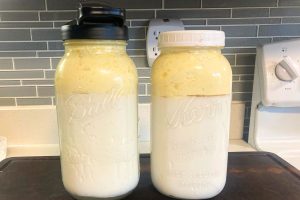





Hi, my name is lene and this is my first time making sauerkraut. I followed the recipe exactly and it has still been sitting for 10 days. There has been no bubbling at all and there’s still liquid on the top so the sauerkraut is still submerged, but it doesn’t seem to be fermenting what did I do wrong. I thought I did everything right I followed the recipe to the tea.
Hi Lene, the speed of the fermentation process depends on how warm the room temperature is around it. It usually takes longer to ferment at cooler temperatures. For example, during the winter months when my house is around 60-68 degrees Fahrenheit, I sometimes let the sauerkraut ferment for a whole month. During the summer months when our house is in the 70s, it tends to ferment in a week or two. It may just need more time. When I was first starting to make it, I would taste it quite often to determine if it had the fermented taste I was going for. As I have gotten more experienced with it, I now can tell from the smell and looks of the cabbage when it’s done.